The Math Surgeon

The Math Surgeon
The Math Surgeon StrickCo

Thursday, August 16, 2012

Distance Learning {Leading the Future}


Future of e-Learning
As I reflect on distance learning in today’s society, I foresee more adult learners returning to school to further their education.  Is distance learning becoming an innovative standard measure to learning?  Yes, I think it is.  Conventional ways of learning will always be accepted because of the longevity of universities and traditional schools.  Have organizations attitudes become more acceptable to online education?  Based on an asynchronous questionnaire I did by a diverse group of learners, I would say yes they have.  Pedagogies of education have changed over the years and require more active participation from learners.  Online learning not only gives learners the ability to use top notch technology for their everyday learning, but it also give learners a chance to model, reflect and debate their work using multimedia designs, wikis, blogs, software packages and the internet.

Active participation in a classroom among learners is a form of learning.  Using modern technology to demonstrate work keeps users competitive in the global workforce.   In five to ten years, I see the industry continuously growing with online learners.  Technology is always revolving and using technologies for resources in education will become more valuable to learners.  Instructional Designers will be more prevalent in the years to come.  I think there will not only be a demand for instructional designers in Academia but also in different businesses across the world.   Traditional settings of education have to keep up with the demands of technology in education, but in my opinion, online learning has an advantage in new innovative measures to learning.  What does this mean in theory?  Distance Learning will become a leading force in education in ten to twenty years.  Why do I say this?  Technology is leading industries today in many facets of learning and maintaining daily businesses.   The downside to technology evolving so fast is businesses not having the time invested to train more individuals in the field.  “Regardless of these many obstacles and challenges, distance learning is, and will continue to be, an integral part of higher education. It provides much greater access to college credit and will substantially increase the number of degrees completed while minimizing the cost of those degrees” (Lutz III, 2012).

As more adult learners transcend to online learning with constant dialog and feedback of distance learning experiences most industries will have to emerge to the demand of learners.  To prepare for a number of growing online learning institutions the industry must have qualified instructors to teach online learning.  I was reading an article by Gambescia and Paolucci (2009) that listed one of the online attributes to providing a successful online learning experience is using highly qualified classroom faculty to also teach distance-learning classes.  I am not sure if I agree with this theory.  Some traditional teachers are not technology savvy and may not be able to confirm to the virtual world of learning.  Even in academia, I was surprise to learn that some professors are still using traditional ways of teaching and/or not using modern technology for learning resources.  Instructional designers bring experience and learning theories to the world of cyber learning.  Skills are an essential part of the learning rubric to giving learners the necessary pedagogies to learning.  As an instructional designer, I will help to foster the perception of hiring more instructional designers to educate students online.  Having the skills to educate students globally not only aide to different strategies of learning but it also brings a skill of what is needed to course management systems to insure that learners are getting the necessary resources and software tutorials that they need in order to succeed as a distance learner.  As an instructional designer, I feel very strongly about learners having the right e-learning experience.  I will continue to speak highly of online learning to help change negative perceptions of distance learning.

The acceptance of distance learning includes the ability to communicate online, experience with new tools, and have the ability to communicate with a diverse and global group of learners (Siemens).  Even though distance learning may have some challenges to novice technical learners and traditional learners, it is still going to be a thriving force in the future.  What makes the distance learning experience achieve its highest point of learning?  The instructors, learning management systems, multimedia designs and innovative technologies are all important measures to produce high levels of learning that an online community creates.  As more adult learners return to education and as more business control financial restraints there will always be a need for online learning.  I will continue to foster positive perceptions of distance learning in hopes of having the forum become the leading institution for learning.
  
References


Gambescia, S. F., & Paolucci, R. (2009). Academic fidelity and integrity as attributes of university online degree program offerings. Online Journal of Distance Learning Administration, 12(1), Retrieved from http://www.westga.edu/~distance/ojdla/spring121/gambescia121.html

Lutz III, J. A. (2012). Distance learning and the future of higher education. Richmond Times-Dispatch, Retrieved from http://www2.timesdispatch.com/news/oped/2012/aug/12/tdopin02-lutz-distance-learning-and-the-future-of--ar-2123475/


Saturday, July 28, 2012

The Influence of Open Culture-An Alternative Learning Forum

Open Course for ID There are so many opportunities to experience distance learning.  Open courses is one example of how learners can educate themselves on free topics by using the web 2.0, multimedia designs and other technological forms.  Have you ever asked yourself what goes into planning such an arena of learning?  “Instructional design should consider all aspects of the instructional environment, following a well-organized procedure that provides guidance to even the novice distance instructor” (Albright, Simonson, Smaldino & Zvacek, 2000-2012, p. 151).  Are all distance-learning programs engaging to learners?  Do they have all of the mechanism that goes into producing quality work for cyber learners?  As I analyzed some of the open courses, I immediately searched for some topics that interest me, then I proceeded to look at the material.  Some of the programs did not grab my attention.  Maybe the format could have been more appealing for a distance-learning course and/or the topic did not interest me.  As I searched for a revelation, I wanted to review courses that were designed for a distance-learning environment and engaged active learning.  Some of the courses did have some characteristics of a good online module.

Art and visual thinking have always fascinated me.  Therefore, I decided to view some classes on visual thinking using art forms as displays.   I used Open Culture (Open Culture, 2006-2012) to find some courses on visual thinking.  One of the free classes I found interesting was Practice of Art 8-Introduction to Visual Thinking (UC Berkeley, 2011).  This open course uses art to analyze by just looking at different types of artwork.  The instructor engages learners and shares their viewpoint on many different artifacts.

This course has 10 lectures, and I reviewed most of them.  As we know art work does not contain much words but it allows learners to use visual senses to interpret art.   The classes gave a lot of informative information regarding the subject.  It also displayed many interesting graphics, which aided to the learning.  The instructor clearly understood the learner characteristics and how to apply the information to the learners (Albright, Simonson, Smaldino & Zvacek, 2000-2012).  I think the media selection was also beneficial for asynchronous learners.  The instructor used YouTube to display the classes.  I think this is an excellent platform for learners.  It is global and virtually used by many people.  “Too often, instructors do not place enough emphasis on designing and using quality visual material” (p. 159).  For this course, I can tell the instructor planned a good medium for the class.  The media is clear and provide alternative viewing methods.  Learners can share the video and place the embed code in a web document or blog.   The audio was mostly clear.  I did hear some noise and static during the videos, but this was minor.  Most of all I think this course designer did plan for distance learning by using Web 2.0, multimedia designs, audio, and video.

Internet based distance learning has to engage learners and provide a medium that is welcoming to adult learners.  There are people who have not experienced the wonderful world of cyber learning.  Open courses provide free online courses for learners to be acclimated with an innovative way of learning.  How can learners know if a course was pre-planned for distance learning?  How can learners know if they are benefiting from cyber learning by using new technologies and online materials?  Online courses should promote active learning by appealing the audience.  Audio, graphics, video, and lectures should promote learning by the audience.  The instructional designer has to provide an avenue of learning that is conducive to the learning audience this includes, designing and developing a module that includes a course management system or a forum for viewing materials such as YouTube, or Wiki sites.   Open Culture provides a forum to review free courses using modern technology.  Learners can experience the virtual world of learning and all of the benefits it has to offer.

References
Albright, M., Simonson, M., Smaldino, S., & Zvacek, S. (2000-2012). Teaching and learning at a distance foundations of distance education. (5th ed., pp. 150-192). Boston, MA: Allyn & Bacon.
Open Culture. (2006-2012). 500 free online courses from top universities. Retrieved from http://www.openculture.com/freeonlinecourses
UC Berkeley. (Producer) (2011). Practice of art 8 - lecture 1 introduction to visual thinking [Web]. Retrieved from http://youtu.be/n0jmaarz2RY

Thursday, July 12, 2012

Choosing Technologies for Asynchronous Training

Untitled Document

An Asynchronous-learning environment has to be able to connect e-learners new information using multimedia designs and the web 2.0.  For this training, the learning audience must be able to understand systematic procedures on how to operate the different types of machinery on the plant floor.  The training must be available to all employees regardless of work availability.  As an ending result, the employees should also be able to demonstrate work based on what they have learned from the training system, and view work from other employees.  How can all of these measures be accomplished with distance learning?

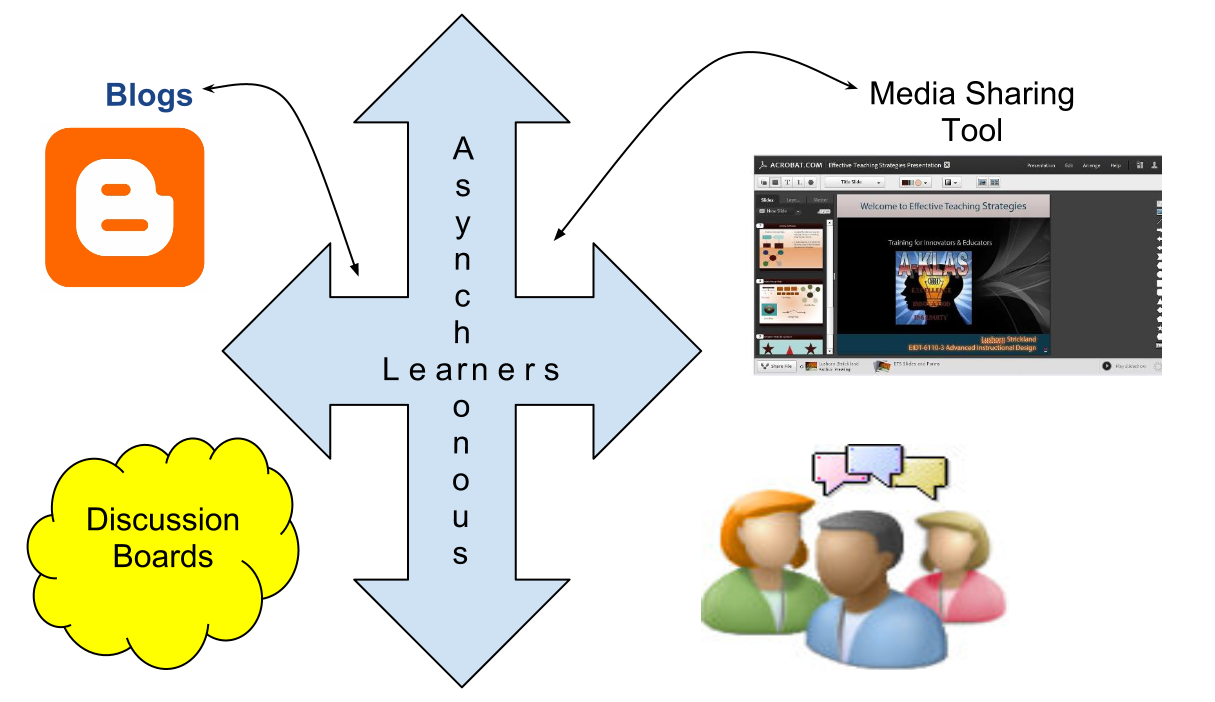
Course management systems are very fundamental to training, but there are other technological tools that can also be useful. The learning system or module must be able to connect to learners through blogs, discussion boards, and media sharing tools.  There are several types of sharing tools available for trainers.  Adobe Connect, Acrobat, Camstudio, blogs, and Wikispaces are a few tools that could be used for this training.  Blogs and Wikispaces seem to be the best format.  With Wikispaces, students can share online file storage space and review each other’s work.  “Users can in tern comment on the presentations and share their own ideas thereby providing feedback that may assist presenters in enhancing their content” (Walden.edu, 2012).   Wikispaces also promotes learners engagement in the lessons by group collaborations and communications on projects.  For a sample look at the benefits of wikispaces click on A-KLAS Consulting Group.  A-KLAS used wikispaces to collaborate on a project.  Students were able to engage in the lesson and assist each other with their project assignments.  The professor was also able to communicate changes and monitor the progress of the group. 


Blogs can also be used for initial training, feedback and collaboration also.  Instructional Designers can provide links in blogs to wikispaces to provide a venue for learners to demonstrate what they have learned and communicate with one another.  Both media sharing tools can conjoin with each other to benefit learners.

Web 2.0 technologies are becoming an educational alternative to learners.  Blogging, Wikis, Podcasting, Social Bookmarking, Social Networking, and Virtual Worlds are all incorporated into course management systems (Albright, Simonson, Smaldino & Zvacek, 200-2012, pp. 128-131).  Depending on the training the ID is performing, can depend on what multimedia sources the trainer will utilize in the learning management system.  Sometimes training can utilize the web 2.0 for instruction, collaboration, demonstrations, and feedback.  The training class for a biodiesel manufacturing plant utilizes several training modules that can be incorporated into a wiki.  This platform provides many facets of multimedia designs including links, videos, collaboration, and on-going feedback from the professor.

References

Albright, M., Simonson, M., Smaldino, S., & Zvacek, S. (200-2012). Teaching and learning at a distance foundations of distance education. (5th ed., pp. 127-132). Boston, MA: Allyn & Bacon.

Common Craft. (Producer) (2007). Wetpaint wikis in plain english [Web]. Retrieved from http://www.youtube.com/watch?v=F7BAU2XX5Ws

Waldenu.edu. (Producer). (2012). The technology of distance education. [Web Video]. Retrieved from https://class.waldenu.edu/webapps/portal/frameset.jsp?tab_tab_group_id=_2_1&url=/webapps/blackboard/execute/launcher?type=Course&id=_1341074_1&url=